


For Business Owner: Understanding Worker Compensation Insurance in CA

Worker Compensation insurance is a crucial aspect of employee welfare and business operations in California. This document aims to provide a comprehensive overview of Worker Compensation insurance, including its purpose, benefits, requirements, and the claims process. Understanding these elements is essential for both employers and employees to ensure a safe and compliant workplace.
What is Worker Compensation Insurance?
Worker Compensation insurance is a type of insurance that provides financial and medical benefits to employees who are injured or become ill as a direct result of their job. In California, this insurance is mandated by law for most employers, ensuring that workers receive necessary care and compensation without needing to prove fault.
Purpose of Worker Compensation Insurance
- For employees, it ensures that they receive medical treatment and wage replacement if they are injured on the job.
- For employers, it limits their liability in case of workplace injuries, as employees generally cannot sue their employers for work-related injuries if they are covered by Worker Compensation.
Benefits of Worker Compensation Insurance
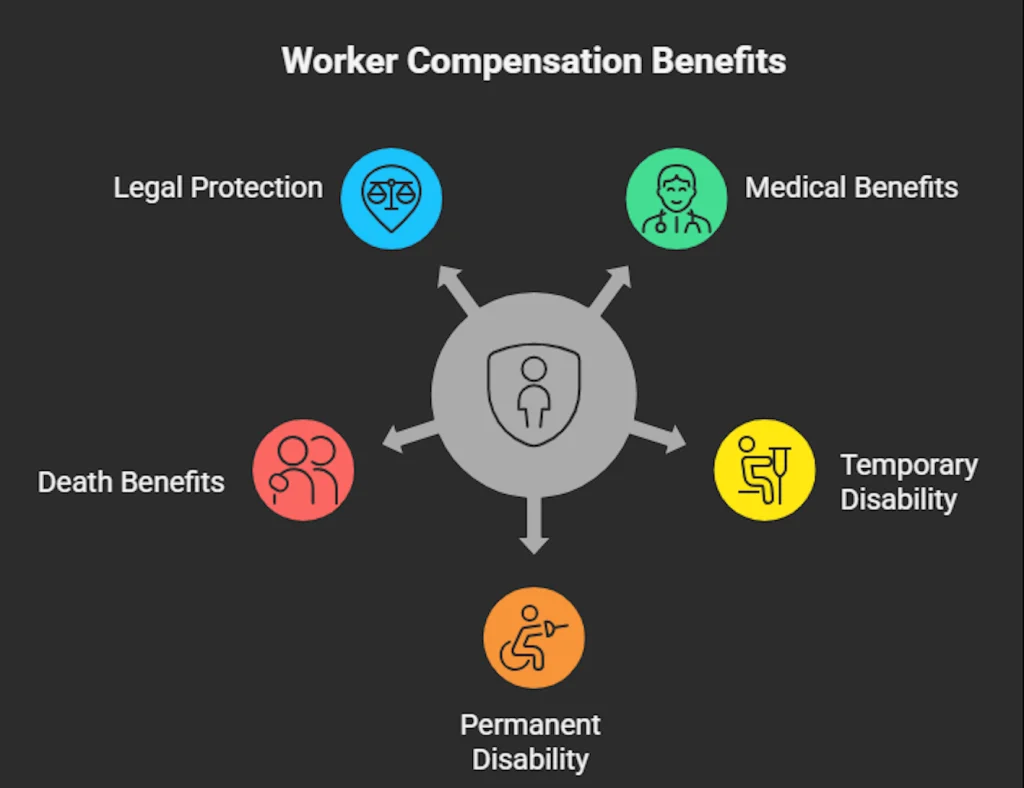
- Medical Benefits: Covers medical expenses related to the injury or illness, including hospital visits, surgeries, and rehabilitation.
- Temporary Disability Benefits: Provides wage replacement for employees who are unable to work due to their injury or illness.
- Permanent Disability Benefits: Offers compensation for employees who suffer long-term or permanent impairments.
Death Benefits: Provides financial support to the dependents of employees who die as a result of a work-related injury or illness.
Legal Protection: Protects employers from lawsuits related to workplace injuries, as long as they have Worker Compensation insurance.
Requirements for Worker Compensation Insurance in California
- Mandatory Coverage: Employers with one or more employees must provide Worker Compensation insurance.
- Insurance Providers: Employers can purchase insurance from private insurance companies, or they can self-insure if they meet specific criteria set by the state.
- Posting Requirements: Employers must display a notice informing employees of their rights under Worker Compensation laws.
- Reporting Injuries: Employers are required to report any workplace injuries to their insurance provider promptly.
The Claims Process
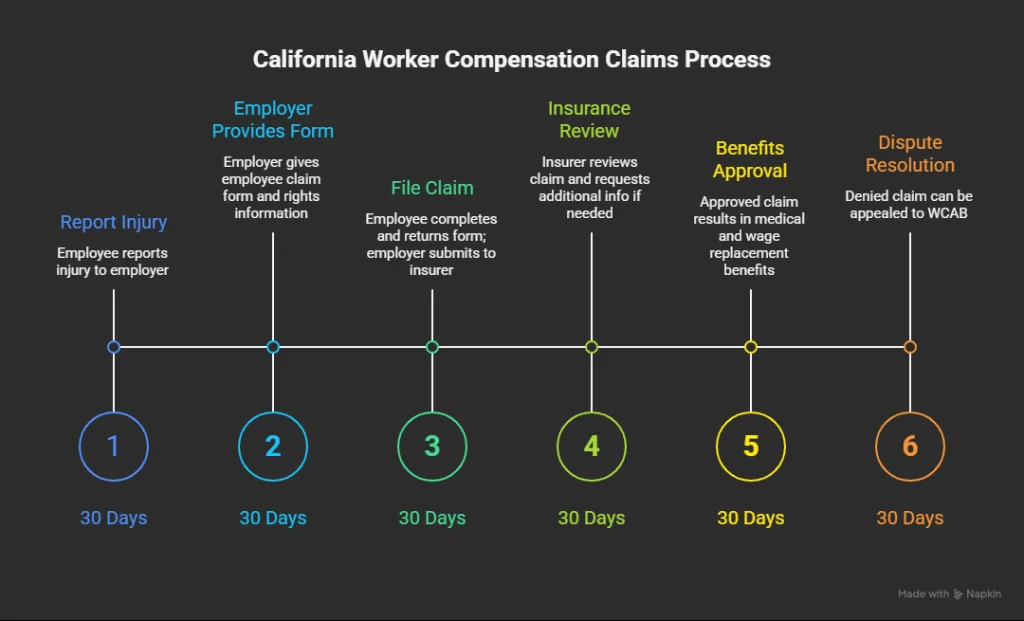
- Report the Injury: Employees must report their injury to their employer as soon as possible, ideally within 30 days.
- Employer’s Responsibilities: Once notified, the employer must provide the employee with a claim form (DWC 1) and information about their rights.
- Filing the Claim: The employee completes theclaim form and returns it to the employer, who then submits it to the insurance company.
Insurance Review: The insurance company reviews the claim and determines whether it is valid. They may request additional information or medical records.
- Benefits Approval: If the claim is approved, the employee will receive medical benefits and wage replacement as applicable.
- Dispute Resolution: If a claim is denied, the employee has the right to appeal the decision through the Workers’ Compensation Appeals Board (WCAB).
Common Misconceptions
- Only Physical Injuries are Covered: Many people believe that only physical injuries are covered under Worker Compensation. However, it also includes mental health issues and occupational diseases.
- You Can Sue Your Employer: While employees can sue third parties for negligence, they generally cannot sue their employer for work-related injuries if they are covered by Worker Compensation.
- Coverage is Optional: Some employers think that Worker Compensation insurance is optional, but it is mandatory for most businesses in California.
Conclusion
Popular Posts
New funding opportunity from the State of California
We’re excited to share a new funding opportunity from the State of California that could support entrepreneurs and community-oriented small business initiatives across the state.
Social Entrepreneurs for Economic Development 3 (SEED 3)
This grant program aims to encourage and support entrepreneurship among individuals who face significant barriers to employment — particularly those with limited English proficiency and immigrants — by providing micro-grants, entrepreneurial training, and technical assistance to help start or sustain small businesses that address social needs in their communities. (California Grants Portal)

What the SEED 3 Grant Offers
- Purpose: Support entrepreneurs in launching or maintaining businesses that address community needs and social challenges. (California Grants Portal)
- Target populations: Individuals who face employment barriers, including those with limited English proficiency and non-citizens (including DACA or TPS recipients), as well as U.S. citizens within those groups. (California Grants Portal)
- Who can apply: Businesses, individuals, nonprofits, legal entities, public agencies, and tribal governments. (California Grants Portal)
- Total funding: Approximately $6,750,000 available statewide. (California Grants Portal)
Why this matters
- Encourages inclusive economic development
- Helps overcome barriers to business ownership and growth.
- Provides both financial support and valuable training.
Important Dates
- The grant is expected to open January 26, 2026. (California Grants Portal)
- Full application details and guidelines will be available at that time via the California Grants Portal.
This opportunity could be highly valuable for entrepreneurs ready to make a positive impact in their communities while building a sustainable business.
For full details, eligibility criteria, and application instructions, please visit the California Grants Portal. If you would like assistance reviewing your eligibility or preparing an application, feel free to reach out.
California Small Business Alert: How to Get Up to $2,000 for Paid Family Leave Expenses
As a small business owner in California, you know that when an employee takes time off to bond with a new child or care for a sick family member, the impact is felt across the entire team. While California’s Paid Family Leave (PFL) program helps your employees with wage replacement, the burden of covering their duties often falls on your shoulders—and your budget.

The good news? The Paid Family Leave Small Business (PFL SB 4) Grant is here to help you bridge that gap.
1. What is the PFL SB 4 Grant?
Administered by the California Employment Training Panel (ETP) and the Labor and Workforce Development Agency (LWDA), this grant program is designed to help small businesses offset the costs associated with an employee being out on PFL.
Whether you need to cross-train existing staff to pick up the slack or hire and train a temporary replacement, this grant provides direct financial relief to keep your operations running smoothly.
2. How Much Can You Receive?
The grant amount depends on the size of your workforce:
- Businesses with 1–50 employees: Eligible for $2,000 per employee utilizing PFL.
- Businesses with 51–100 employees: Eligible for $1,000 per employee utilizing PFL.
3. What Can the Funds Be Used For?
The grant is flexible, allowing you to cover various “out-of-pocket” costs that arise when an employee is on leave, including:
- Cross-training: Paying for the time and resources to train current employees to handle new duties.
- Upskilling: Improving the skills of remaining staff to ensure productivity doesn’t drop.
- Recruitment: Covering marketing and hiring costs if you need to bring in temporary help.

4. Is Your Business Eligible?
To qualify for the PFL SB 4 Grant, your business must meet the following criteria:
- Size: Employ between 1 and 100 employees.
- PFL Usage: Have at least one employee who is currently utilizing (or has recently utilized) the California PFL program.
- Registration: Be registered to do business in California and in “Active” status with the Secretary of State.
- Tax ID: Have an active California Employer Account Number (CEAN).
Note for PEO Users: If you use a Professional Employer Organization (PEO) for payroll, you are only eligible if your company is listed as the employer on the CEAN. If you file under the PEO’s account number, you may not qualify.

5. How to Apply
The application process is designed to be quick—typically taking about 15–20 minutes. You will need:
- Your 8-digit California Employer Account Number (CEAN).
- Your business’s NAICS code.
- The 10-digit EDD Customer Account Number of the employee on leave.
The current window for applications is open, but funds are often distributed on a first-come, first-served basis. If you have employees planning for leave or currently away, now is the time to act.
Apply or learn more at:
Why “Good Years” Are When Smart Business Owners Fix Risk
Most business owners think about insurance and risk only when something goes wrong.
- A fire.
- A lawsuit.
- A cyber scare.
- A claim they didn’t expect — or worse, one that wasn’t covered.
But here’s the truth we see every day at SohoSocal: The best time to fix risk is when nothing is broken. And January — when businesses are profitable, focused, and planning — is the most overlooked opportunity to protect everything you’ve built.
1. The Dangerous Comfort of a “Good Year”
If last year was strong, you’re not alone.
- Revenue grew.
- Staff expanded.
- New locations, new equipment, new clients.

That’s great news — but it comes with a quiet side effect: Your risk almost always grows faster than your insurance.
We regularly meet successful business owners who:
- Haven’t updated coverage in years
- Added payroll, locations, or services without adjusting limits
- Assume “we’ve never had a claim” means “we’re fine”
Unfortunately, that assumption is often what turns a manageable loss into a major setback.
2. Risk Doesn’t Show Up Loud — It Builds Quietly
Most serious losses don’t come from dramatic events. They come from small gaps:
- Haven’t updated coverage in years
- Added payroll, locations, or services without adjusting limits
- Assume “we’ve never had a claim” means “we’re fine”

None of these feel urgent. Until suddenly, they were.
3. Insurance Is Not the Strategy — It’s the Tool
This is where many business owners get frustrated.
They don’t want:
What they do want is:
- More paperwork
- More policies
- More premium
- Fewer surprises
- Predictable outcomes
- Confidence that one incident won’t undo years of work
They don’t want:
- More paperwork
- More policies
- More premium
What they do want is:
- Fewer surprises
- Predictable outcomes
- Confidence that one incident won’t undo years of work
That’s why we believe insurance should support a risk strategy, not replace one.

At SohoSocal, we look at:
- How your business actually operates
- Where losses would hurt the most (cash flow, reputation, growth)
- Which risks you should transfer, reduce, or simply be aware of
Because not every risk needs more coverage — but every risk should be intentional.
4. Why January Matters More Than You Think
January is powerful because:
- Claims history is clean and fresh
- Underwriters are more flexible
- Budgets are being set, not squeezed
- Decisions are proactive — not emotional

In other words, it’s when smart adjustments cost the least and protect the most. Instead of asking: “Do I have insurance?” – Try asking: “If something unexpected happened this year, would my business recover — or react?”
That answer tells you everything.
5. A Final Thought
- Risk planning isn’t about fear.
- It’s about freedom.
- Freedom to grow.
- Freedom to hire.
- Freedom to take opportunities — knowing your foundation is solid.
That’s what we help business owners build every day.
If January is the month you get clear on risk, the rest of the year gets easier.
—
SohoSocal Risk Intelligence
Helping business owners protect what they’re building — and why it matters.